
10 min read
The Power of Words: Peter Berry and Deb Bunt Champion Dementia Awareness
Co-authors, cycling partners and campaigners: the story behind it all

Written by:
Deb Bunt and Peter Berry
"Life with Dementia isn't over - it's just a little different." - Peter Berry
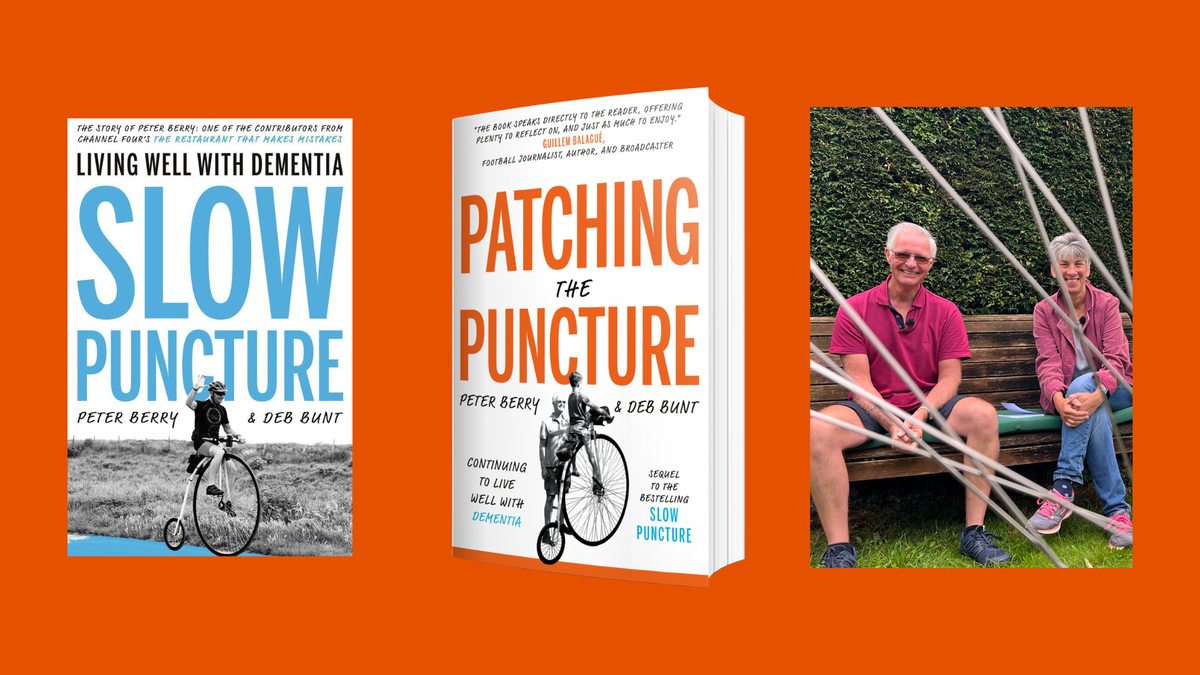
Peter Berry was diagnosed with young onset Alzheimer's when he was fifty and, with a life expectancy of eight to ten years, set about proving that it is possible to live well with this condition. It was after his diagnosis that he met Deb Bunt, who was newly relocated to Suffolk. He introduced her to cycling, and she captured his experience of living with dementia. Together, they have raised awareness for dementia, and formed a wonderful friendship that has changed both of their lives.
Their methods of raising awarness have been vast, but to name a few: Peter has cycled from Aberystwyth to Aldebrugh on a Penny farthing, rode 1,500 miles in the winter months, uploaded videos on Youtube about living with dementia, appeared on The Restaurant that Makes Mistakes in 2019, delivered plenty of talks and events, been made the Patron for CIC (a group empowering people living with dementia and their families), and feature regularly on their local radio in their home county, Suffolk. Of course, we cannot forget the publication of Slow Puncture in 2020, a memoir that looks to living with the present and coping with dementia, as well as Patching the Puncture, which will be published on 28 February 2026.
As a result of all their efforts, they were honoured with the Wendy Mitchell Award for their outstanding contribution to dementia education and awareness at the end of 2025.
What they've achieved together is nothing short of astounding so, in honour of Race Against Dementia Day and to celebrate Peter and Deb's upcoming publication of Patching the Puncture, we reached out to learn more about their friendship, how their experiences shaped their writing and how their work has led them to collaborate with some important and meaningful companies.
You both have clearly formed a wonderful friendship over the years. Could you tell us a bit more about how you met and how this friendship evolved over the years?
Peter and I met in 2018. My husband, Martin, and I had taken early retirement and moved to Suffolk from London and we didn’t know anyone. I’d popped into our local cycle shop just in the hope of finding someone to talk to and the owner mentioned a man (Peter Berry) who had just completed a cycle ride from Aberystwyth back to Aldeburgh (ie across the country) and how amazing this was. I’d said a rather perfunctory “uh-huh” and she told me he had Alzheimer’s and, to be honest, I thought nothing more of it. The next time I popped into the shop, I made some fatuous remark about needing to meet the famous Peter Berry and he was standing right by me. We got chatting and he offered to take me out on some cycle rides. That’s how things roll in rural Suffolk! 41,000 miles later we are still cycling together.
The friendship definitely has evolved: to start with I sensed Peter was a little guarded about what he shared with me, but gradually he started to feel more comfortable and was more able to talk more freely about his condition. Equally, I started to understand what was needed to support him in order to maintain this friendship. It’s easy to fall into the trap that Peter knows me well: he doesn’t – he feels the emotional friendship in his heart but he knows very little about me, no more than three or four facts. So it’s a friendship lived in the moment – a microcosm of Peter’s everyday life. Even now, he couldn’t describe what I look like but when he sees me, he knows who I am, and I make some reference to that in the new book. But what matters is that we have created a deep and meaningful friendship where we support each other, and we are both the beneficiaries. Our friendship is embedded in both our lives, and we have given - and will continue to give - so much to each other for as long as we can.
For Deb: you’ve long had aspirations about being an author. When did this dream come about? How does it feel to be not only an author, but an author of such an important book?
The writing dream was fulfilled when Slow Puncture was published in 2020. Over the years, I had tried my hand at novel writing and had got as far as finding an agent but that was it; I had also had some short stories published in magazines. But it wasn’t until I met Peter in 2018 that I suppose I found my muse, and the writing flowed. It’s true that you should write something you feel passionately about. I was extremely keen to share Peter’s words and his story, but also to share how my understanding of Alzheimer’s had changed and how my preconceptions and stereotypes had been challenged.
I often tell Peter that he has changed my life. I feel privileged to have written our story (because it is OUR story) and honoured and also slightly bemused that people are still reading it! I think many of us suffer from imposter syndrome and the fact that Slow Puncture (and hopefully Patching the Puncture) has been received so well and read across the world helps to dispel some of that syndrome and makes me immeasurably proud. I am so glad that Peter had the courage to share his story with honesty – the good and the bad.
For Peter: How have you found the process of sharing your story, and shaping it into a book?
"I can’t really make any comments about the process. What I can talk about is the feeling this creates in me. When Deb tells me something about the book, or that someone has read it and found it useful, these are the emotions I sit with: pride, pleasure and feelings of a sense of purpose and self-worth" - Peter Berry
I’ve not read either of the books and I won’t do now. I can still read but by the time I’ve read one line and started the next line, I’ve forgotten the first line. That’s immensely frustrating. So I know there is a book (and now I’m just beginning to remember that there is another book and apparently the title was my idea!) but I can’t really make any comments about the process. What I can talk about is the feeling this creates in me. When Deb tells me something about the book, or that someone has read it and found it useful, these are the emotions I sit with: pride, pleasure and feelings of a sense of purpose and self-worth. This is so important to me. My contribution to the process was minimal. I appreciated it that Deb would tell me what she had written, but whatever she had said, it quickly went. But you know, that doesn’t matter. What matters is that there is a book and that people are enjoying it and finding it helpful.
Can you tell us a bit more about what inspired you to write Slow Puncture, as well as the process behind it?
The first year I spent with Peter was fascinating. I joined him in his cycling challenges (the four counties penny farthing challenge springs to mind) and heard him talk about Alzheimer's and how it impacts him. I heard how he expressed himself through his amazing metaphors and almost poetic descriptions. It was as if he had taken the top of his head off and allowed me rummage inside to see what was going on. What an absolute privilege! And that was the inspiration behind the book. I had started to blog for Peter on his Facebook page, so I had some information to hand, but the real process was to sit down and write about something that we had done together, from his perspective and from mine. Peter’s voice was very clear in my head, so I knew I was representing him as accurately as possible. The process was hindered by the fact that I have a slightly chaotic personality – sometimes I can write for hours on end, other times I become restless and lose interest. So the process was as ad hoc as my personality.
When I was ‘stuck’ with the writing or just fidgety, I would take one of my bikes and cycle through the countryside, perhaps forty or fifty miles, to burn the energy and to filter through the ideas in my head. The endorphin surge and sheer exhaustion generally helped to focus my mind on the writing so, when I did sit down at the computer, I was able to spend a long while writing and re-writing paragraphs until I felt the book represented our two distinct voices with our own perspectives. I think I would call the process ‘haphazard’ and wouldn’t recommend it to others as a model to base their own style!
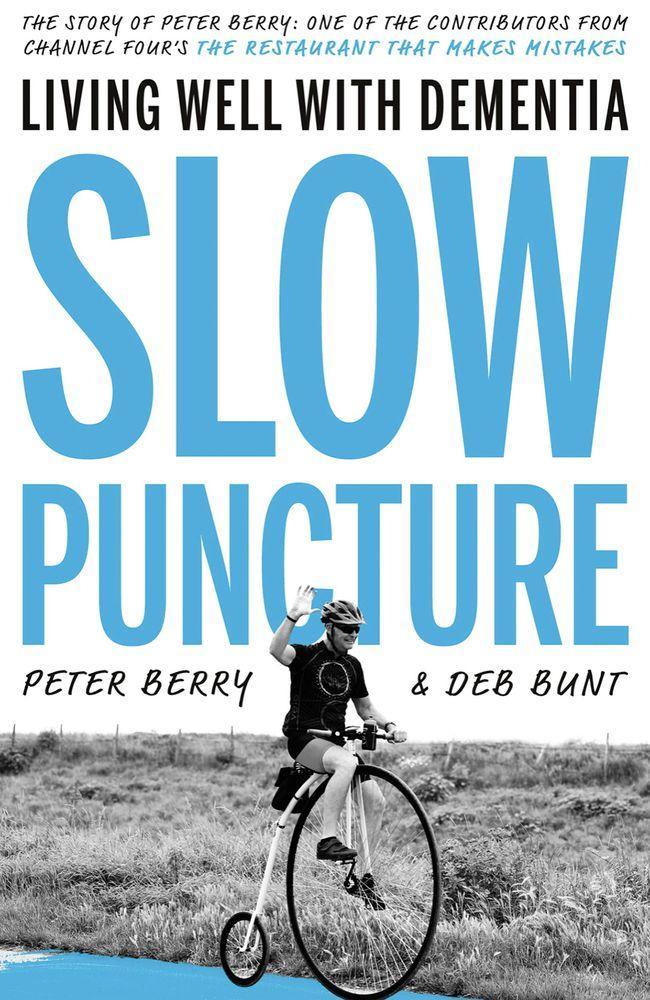 Slow Puncture, which was published with The Book Guild in 2020.
How do you feel in the run-up to the publication of Patching the Puncture?
I am impatient to see the book in print, but equally I am beset by the dreaded imposter syndrome again. With Slow Puncture we had nothing to lose, but now we are more well-known, I worry about the hype being stronger than the actual event. However, I am also excited. If space permitted, I could probably do an A – Z of my feelings, but thankfully space is at a premium and so I won’t! If you were to ask Peter this question, he would say “it’ll be fine” because for Peter, everything always is fine, and that’s a good approach to life.
Can you talk to us about the Wendy Mitchell Award? How did the nomination process work, how did you feel when you discovered you’d won?
Wendy Mitchell was a pioneer in bringing the public’s attention to young onset dementia and it’s wonderful to win an award which links us to her. Wendy wrote the short foreword for Slow Puncture, so it feels as if we are all inextricably connected, and that is a real honour. One of our first podcasts was with Pete Hill of The D Word (part of UK Health Radio Network Ltd), and it was he who nominated us for this award. There were five candidates, not just from the UK but from across the world, and the listeners were invited to vote via the website. I was looking after two of my grandsons, who were both unwell, when I received the email telling me we had won. I whooped in as sotto voce a tone as I could muster and resisted the urge to knee slide across the floor. I do hope the boys won’t be scarred for life thinking that it was their illness which so delighted their grandmother…
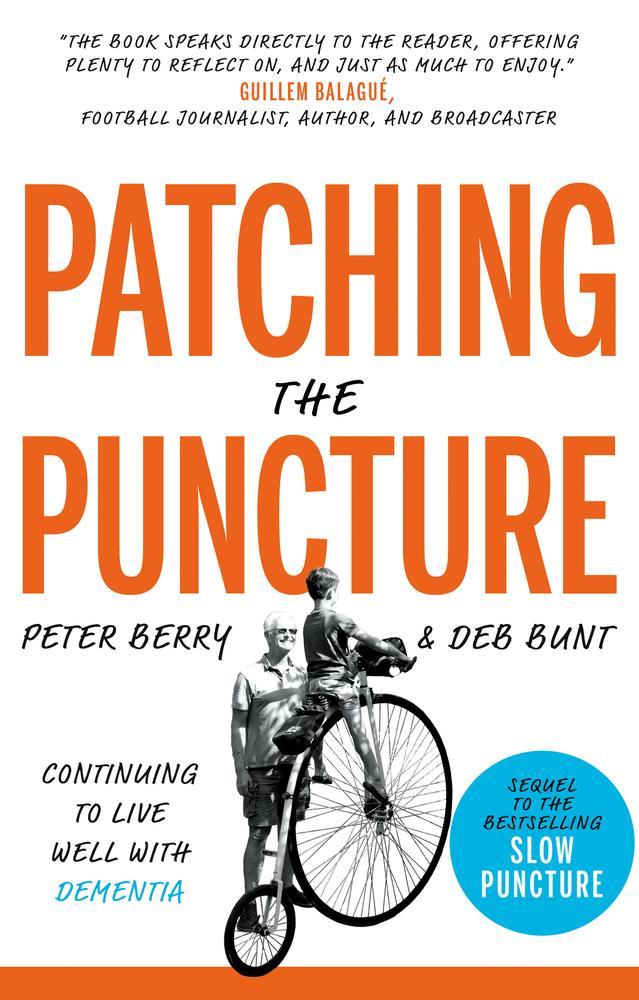 Patching the Puncture, which will be published on the 28 February.
Slow Puncture has The Reading Agency logo and the AlzAuthors logo. Can you talk to us a bit more about your collaboration with Alzheimer charities and groups?
In London, I worked in a sector around vulnerable people, and a major part of my role was to establish good relationships with other agencies in order to work collaboratively. Whilst it’s true I was disillusioned with all of my jobs and felt my skills were not being used, these skills finally had their use in my retirement.
AlzAuthors has been a huge benefit to publicising the book and the organisation works tirelessly to offer people as much information as possible. It’s wonderful to have Slow Puncture and Patching the Puncture as recommended reading matter by them, and it also means Peter’s story will have a greater reach, particularly in the USA. For my part, I do as much as I can to promote AlzAuthors, so it’s a mutually beneficial relationship.
Being supported by The Reading Agency is another unexpected bonus and has helped to forge more significant links with the library services. Slow Puncture was selected to be on the Reading Well for Dementia reading list – twenty-one books were selected – and, as part of the launch of this scheme, we were invited to the House of Commons to talk about the book. I am so pleased that we have both of these organisations’ logos on the reprinted versions of Slow Puncture.
Somehow, my networking skills have yielded great benefits, and we are one of the many other loud voices talking about living well with Alzheimer’s. This collaborative work led to us being invited to the Gibraltar Literary Festival in 2024 to talk about our book. More recently, we went to Switzerland to deliver a talk at a major conference and more overseas talks are being planned even as I type.
We don’t fundraise so actively now, but when we do it’s for Alzheimer's Research UK (ARUK), and this is Peter’s charity of choice. Our cycling challenges have raised over £20,000. Peter believes that research is the way forward and that one day a pill will be created which means people with die with Alzheimer’s and not of Alzheimer’s. We don’t charge when we deliver talks but suggest to people that if they want to make a donation then they should do so to ARUK.
Peter and I both believe that together we are stronger and the more we collaborate with organisations and charities, the more his message will be heard: it IS possible to live well with a diagnosis of Alzheimer's and that by having meaningful relationships, positive social interactions and by forming connections, the quality of life for those living with memory impairment is enhanced and prolonged. With the right support and collaboration, care is further down the line. And, as Peter says, we all know what happens when the care process begins.
Slow Puncture is available to purchase from the Book Guild, and Patching the Puncture is available for pre-order, and will be published on the 28th February.
14 Titles and Counting
A Publishing Journey
Now the author of 14 titles, Paul’s journey into publishing is a testament to creativity, perseverance, and adaptability. With a background as a writer for advertising and television, including well-known…
5 min read
Submitting Books for Awards and Competitions
Jane has won multiple awards for her books. How did she do it?
Being an award winner is a dream for any author. But how do you get there?
Book Guild author Jane has written four books, two in the GoldenEars series and two in…
8 min read
Hosting a Successful Author Event
How our authors hosted events that stand out
As a publicist at The Book Guild something I get asked a lot about is author events, book launch parties, readings and/or signings can be a great way to get…
7 min read
Publicity Campaign Success
How our publicity campaign made Johnny Ball's memoir unmissable.
You hear it all the time - more books are being published these days than ever before. Generally, this is a positive thing because it means more authors are accomplishing…
6 min read